“We want to rethink regional journalism”
Written by:
Alexandra Borchardt
How can independent journalism remain present in places where traditional media no longer reach people? DAZWISCHEN combines podcasts, newsletters and events to engage people across Saxony-Anhalt. Our Case Story explores how detektor.fm is testing new approaches to regional journalism and what others can learn from its experience.
In what context was DAZWISCHEN developed by detektor.fm?
DAZWISCHEN is a service developed specifically for Saxony-Anhalt by detektor.fm, a podcast company based in Leipzig. It consists of a regional podcast, a newsletter and events. The project was prompted by concerns about the political future of the state ahead of the state elections in September 2026. Christian Bollert, managing director and co-founder of detektor.fm, and his team identified the weakness of local journalism in the state as one of the factors behind voting behavior. There were also concerns that the AfD might further undermine the integrity of public service broadcasting, which is under attack from right-wing populists across Europe. The jury of Media Forward Fun decided to cooperate with detector.fm on DAZWISCHEN as part of a €500,000 project, the largest amount committed by the fund to date.
What problem is detektor.fm trying to solve with DAZWISCHEN, and for which target audience?
DAZWISCHEN is detektor.fm’s first regional offering. The founders’ hypothesis is that people, particularly those living outside major cities, lack access to journalism that covers issues specific to their region. Germany has news deserts, too, says Christian Bollert, co-founder and managing director of detektor.fm: “We want to rethink local journalism.” Audio-led local journalism in the form of podcasts is rare in Germany, if it exists at all, especially as a regular offering that genuinely engages with a particular region. “Others show up before a state election or when something dramatic happens, and then they quickly disappear again.”
What products does detektor.fm offer?
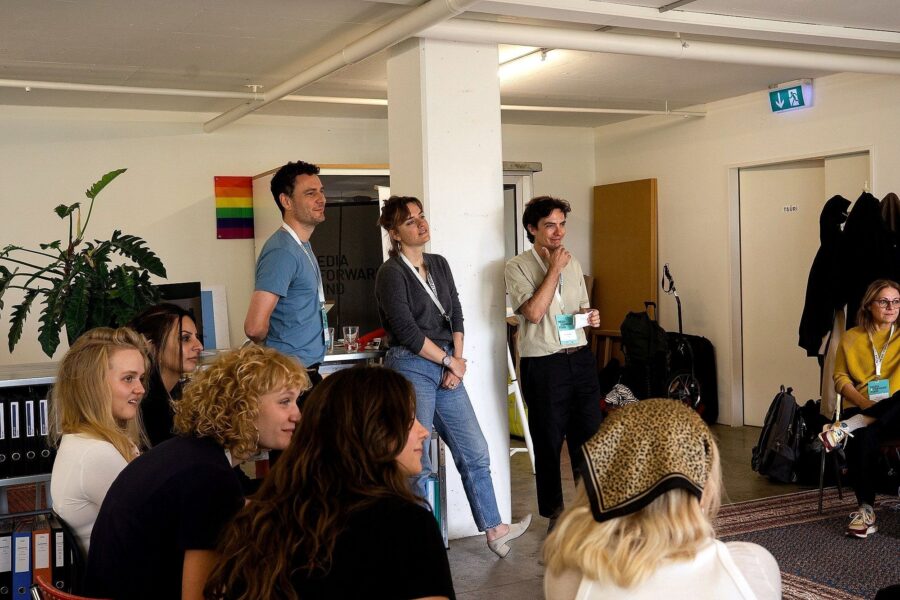
For DAZWISCHEN, detektor.fm has put together a package consisting of a podcast, a newsletter and events. Since the end of March 2026, the podcast has been published weekly, with each episode covering a different regional topic. Examples include trends in employee sick leave in Saxony-Anhalt, a democracy project in Dessau and threats to public service broadcasting. Each episode runs for 30 to 40 minutes and is hosted by two freelance journalists with strong roots in the region. The complementary newsletter is published every Thursday. In autumn 2026, the team had already organised a community event in Halle and, together with Der Tagesspiegel, invited people to an event in Magdeburg on 17 November. The event in Halle focused on civil society in Saxony-Anhalt and the consequences of the election result, while the Magdeburg event will explore the lessons and insights gained by the democratic parties.
What is the business model behind DAZWISCHEN?
DAZWISCHEN aims to combine several business models. By 2028, the goal is for the project to be financed in equal thirds through philanthropic funding, direct revenue from users and regional advertising. At present, the team relies solely on the cooperation with Media Forward Fund. However, it can draw on detektor.fm’s experience in diversifying revenue, as the company itself generates income from a mix of sources. These include advertising, podcast productions for third parties and events such as the Media Days Central Germany. Two community-focused formats are particularly successful commercially: the cycling podcast Antrieb and Gartenradio, a gardening podcast.
What did the team do to develop DAZWISCHEN?
detektor.fm is an established team, which meant the new business could be set up relatively quickly. With the September 2026 state election in mind, the team began planning in early January 2026 and invited 20 civil society stakeholders to a discussion about what Saxony-Anhalt needed. Just three months later, DAZWISCHEN launched its podcast format, and it proved successful. “Practically from day one,” as Bollert puts it, the offering reached 6,000 subscribers, exceeding the team’s own target of 4,000. “Episodes that focus on a specific local issue work particularly well,” says Bollert. The most popular episodes covered village shops and the town of Zerbst, which serves as a statistical twin representative of the state as a whole. An interview with the state premier also made it into the top three.
The newsletter launched at the same time. By autumn, it had more than 1,000 subscribers. The qualitative feedback and the email addresses collected indicate that the offering is reaching people in Saxony-Anhalt and neighboring areas. “For us, this is the better channel because we have users’ email addresses,” says Bollert. The team therefore plans to grow the newsletter significantly. Its calculation is that it will need at least 10,000 email addresses to reach 1,000 paying users.
What resources does the team need?
In autumn 2026, DAZWISCHEN was run by two permanent staff members, one responsible for the podcast and the other for the newsletter. They can also draw on resources from the detektor.fm team in Leipzig, which includes audio production, distribution and marketing, as well as event management. The company has 25 employees in total. The two podcast hosts work as freelance journalists.
How is detektor.fm organized as a company?
Managing director Christian Bollert founded the podcast company in Leipzig in 2009, long before the podcast boom reached Germany. The aim was to develop high-quality audio formats for a digital environment. The management team also includes Claudius Nießen; Stephan Ziegert, who heads the editorial team; Kati Zubek, who leads content distribution; and Steffi Nickel, who is responsible for the events team. The company has a flat hierarchy, the entire team works on a role-based model, and since 2024 it has operated on a four-day working week.
How does detektor.fm decide which products to develop?
For detektor.fm, products such as regularly published podcasts need to be financially viable. However, there are also products with potential that the team continues to develop even if they are not yet profitable, says Bollert. One example is the Grundgesetzpodcast, launched by journalist Rabea Schloz together with Hajo Schumacher to mark the 70th anniversary of Germany’s Basic Law. It went on to become a major success and led to further commissions. The team reviews its performance every autumn. Ideas for new projects also come from within the team. “For a long time, we didn’t even think about regional journalism.” But the collaboration with the Media Forward Fund created an opportunity to develop a blueprint for this kind of offering. “Inspired by the motto ‘If you can make it in New York, you can make it anywhere’, we thought: if we can make it work in Saxony-Anhalt, we can make it work anywhere.” And that is very much the vision.
Bollert is sceptical about the current trend towards video content. “If you make a video podcast with a prominent person, you can reach 100,000 people very quickly. But we don’t believe it makes sense to rely entirely on social media. We strongly believe in platforms we operate ourselves. No tech company can take those away from us.” Taking the open-source platform Mastodon as an example, he says that building an audience there is considerably harder than on Instagram, but followers on Mastodon remain connected over time. “Independence is extremely important to us. We’ve seen for 17 years how volatile TikTok, Instagram and YouTube can be.”
What journalistic principles does detektor.fm follow?
Editorially, too, independence is detektor.fm’s most important principle. An editorial code sets out the standards the team follows. These include the two-person review principle and a limit of 60 seconds for advertising spots. Bollert explains: “We don’t want to be one long advertisement, and we don’t let clients dictate our content. The distinction is clearly audible. Nothing gets blurred.” The editorial team also strives to report as fairly and even-handedly as possible. “Listeners should be able to form their own opinions. We have a very high regard for our users.”
How does detektor.fm measure success?
For podcasts, the key metric is downloads. One million downloads is considered a major success. But quantitative success is not everything, says Bollert. Some podcasts may have limited reach, yet be listened to by half the people working in their target industry. For example, detektor.fm also produces a podcast with brand eins magazine that is widely listened to by people in the business community. “We also want to create work that is journalistically outstanding. What drives us is producing content that matters to society.” detektor.fm has won numerous awards with this approach. In autumn 2026, DAZWISCHEN was also nominated for the Grimme Online Award. For the DAZWISCHEN newsletter, the team aims to reach several thousand subscribers as quickly as possible. For events, the main priority is personal exchange with the local community.
What has detektor.fm learned from DAZWISCHEN?
- The podcast is the funnel that attracts users. Many subsequently subscribe to the newsletter. For most media brands, the process works the other way around: people discover the podcast through the newsletter.
- The most important lesson was to separate the newsletter and the podcast as products. According to Bollert, newsletter subscribers have different needs. Interactive elements such as polls and recurring features like event listings are particularly popular. While the podcast topic remains central to the newsletter, other elements complement it and turn the newsletter into a product in its own right.
- The DAZWISCHEN hosts, Katja Schmidt and Marie Landes, play an anchoring role. They bring credibility and a personal touch to local coverage. Both come from the region, having grown up in Magdeburg and Dessau respectively, and have different experiences of the area. The team tries to include someone who is physically present at the location whenever possible for each episode.
- As expected, DAZWISCHEN benefited significantly from the state election. A large proportion of subscribers joined in the weeks before and after the vote, partly because third-party platforms such as Spotify had listed the offering.
What would detektor.fm do differently next time?
According to Bollert, detektor.fm’s biggest strategic mistake was not launching with a login system. The company was founded in 2009/2010, during a period of technological optimism. “We missed a huge opportunity. Otherwise, we would have hundreds of thousands of email addresses and direct contacts with people today.” Around half a million people have subscribed to detektor.fm podcasts, for example, but the company only has email addresses for a fraction of them.
What surprised the managing director most?
“What surprises me most about DAZWISCHEN is how grateful people are for what we’re doing,” says Bollert. People are genuinely interested in the team’s work. Journalists repeatedly hear that traditional media have not visited their communities for years. “That completely contradicts the widespread idea that people are fed up with the media.” People feel seen, especially members of politically active initiatives. For example, of the 20 institutions and groups detektor.fm contacted before developing DAZWISCHEN, 16 responded that they wanted to be involved in the conversation.
What is the most important piece of advice for other founders?
Bollert says: “Stay optimistic. I believe that if you create something new and digital in journalism, have a genuine motivation behind it and aren’t just trying to make money, it will eventually succeed. You’ll find people who want to join you and contribute.” Persistence is essential, though. “This isn’t something you do for three weeks or six months. It’s a long-distance run.”
Last updated: October 28, 2026