Dorfkönig: An AI Tool for Hyperlocal Information

Written by:
Alexander von Streit
Local media organization Bajour is using AI to add news from surrounding municipalities to its newsletter. Developed together with the We.Publish Foundation, the “Dorfkönig” tool is designed to enable more locally differentiated reporting with limited resources.
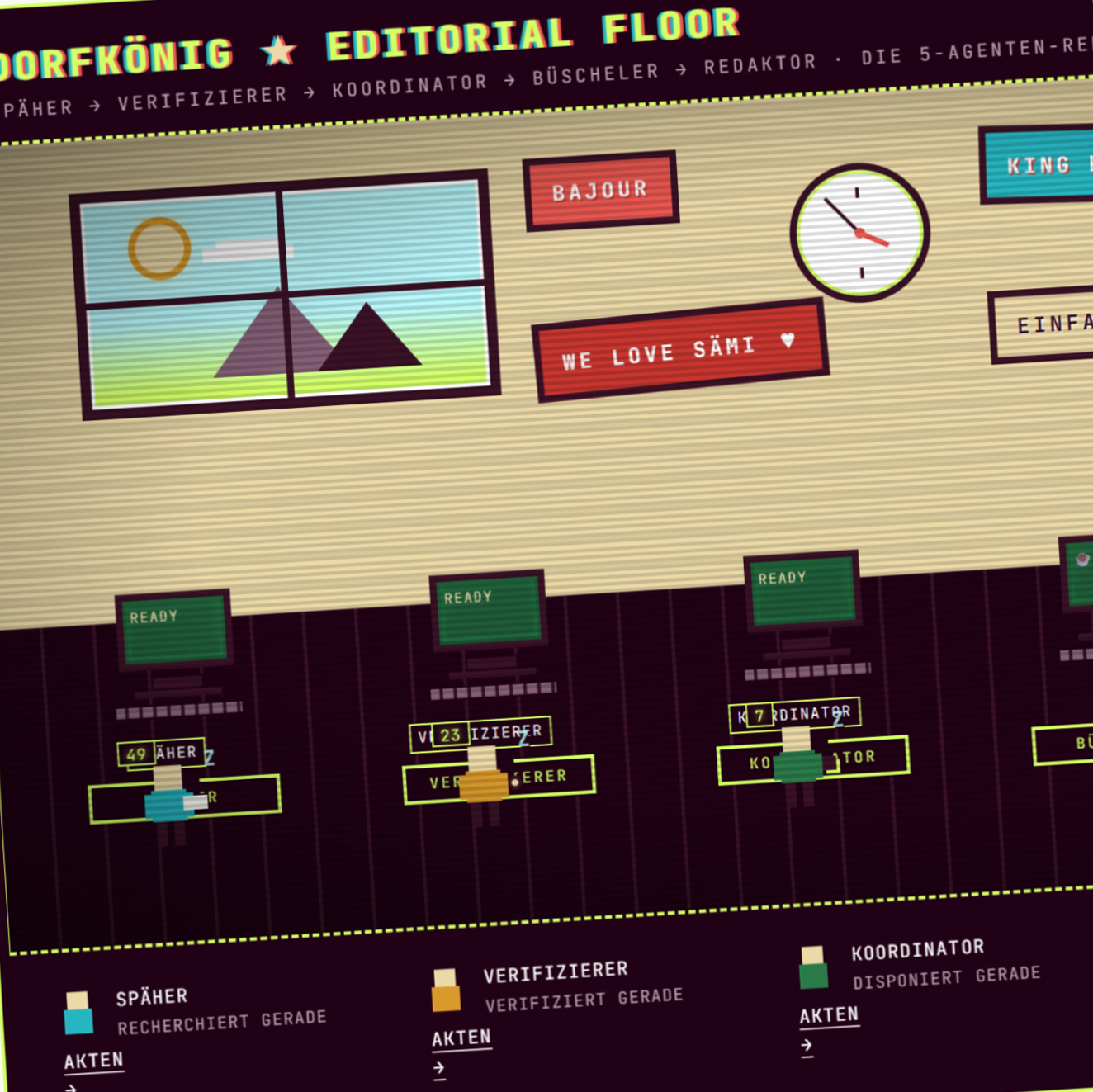
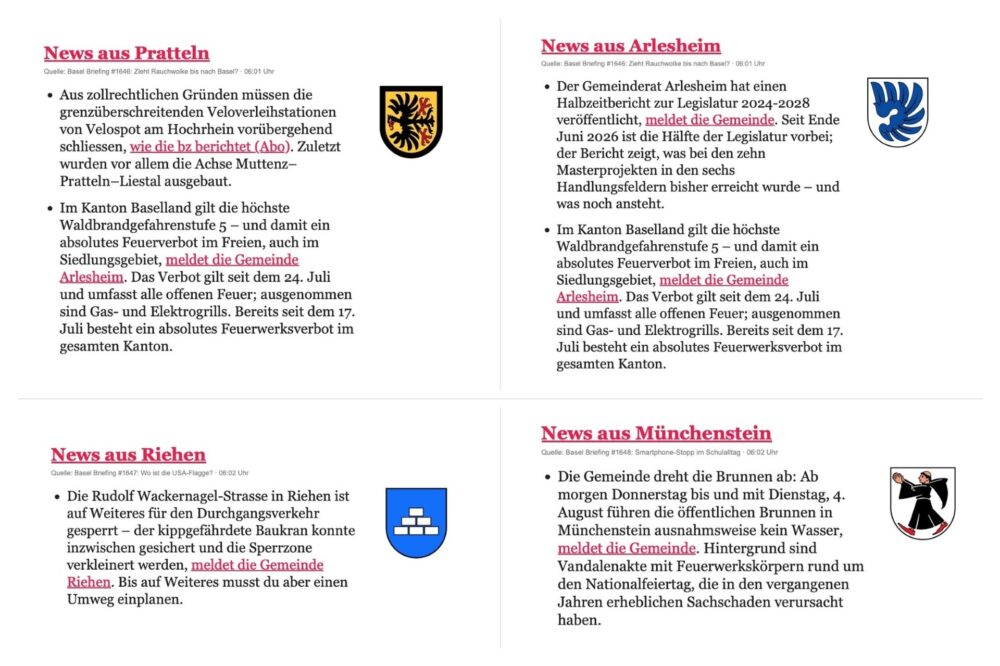
In the afternoon, it’s “Dorfkönig” time at Basel-based city magazine Bajour. The AI tool searches official announcements, local weekly newspapers, community news and other sources for relevant information from several municipalities around the city. It then suggests local news stories for the hyperlocal editions of the “Basel Briefing” newsletter the following morning.
The idea: readers in surrounding municipalities get news from their own municipality in addition to news from Basel, without the small editorial team having to monitor all the different sources themselves and write every story from scratch. Editorial responsibility remains with Bajour.
Product idea: Adding local news to the “Basel Briefing”
Rather than creating a separate newsletter for every municipality, Bajour is building on the existing reach of the “Basel Briefing”, which currently has around 17,000 subscribers. Three short news stories about the city and region are supplemented by two or three local stories specifically for readers in each municipality. This means the editorial team does not have to build a separate media product for every location but can make an existing product more relevant to part of its readership.
The expansion into the surrounding area is supported by Media Forward Fund. The aim was therefore not just to find a solution for the funding period, but an approach that would remain financially viable afterwards. The challenge lies in the daily workload: relevant and up-to-date local news needs to be available five days a week. This takes resources. In Bajour’s view, a purely manual approach would have required significantly more staff. Bajour has strengthened its editorial team but is also relying on software support to expand the offering.
The AI solution developed in-house, “Dorfkönig”, is intended not only to save work but also to enable additional reporting. In some surrounding municipalities, relevant information is available, but scattered across official announcements, event calendars or local publications. It has rarely been brought together journalistically. “What we are doing here is not curating information,” says Samuel Hufschmid, who is leading the project at Bajour: “These really are news deserts, in some cases municipalities with more than 10,000 inhabitants where it is difficult to bring interesting news every single day.”
The editorial assignment is clearly defined. The focus is on service journalism: information such as a road closure, a building application being available for public inspection, or a hiking group inviting people to join an outing. This kind of hyperlocal information is intended to help people in their everyday lives who do not have the time to work their way through different local sources themselves. At the same time, the journalistic product should better reflect the places where they live. The “Dorfkönig” finds and prepares this news but does not conduct independent investigative reporting.
Development: Editorial requirements set the direction
As part of its grants project with the Media Forward Fund, Bajour has been developing the “Dorfkönig” with We.Publish since the beginning of 2026. We.Publish’s publishing software is used by numerous independent local media outlets, particularly in Switzerland. For the “Dorfkönig”, Bajour contributes the editorial requirements and tests the tool in practice, while We.Publish is primarily responsible for the technical development. After experimenting with training and different language models, the team opted for an “open-source agent framework”: rather than having a single language model handle the entire task, it is divided into several steps and tools. “A week later, we already had a ‘Dorfkönig’ that worked,” says Jolanda Spiess, who is responsible for developing the AI tool at We.Publish. “But we knew that it now had to become really reliable, be perfected and closely monitored.”
It starts with access to the sources. The tool reads websites using, among other things, a scraper developed in-house and integrates structured data from authorities via interfaces. There are also dedicated connections for other documents and a custom-built connection to local Facebook groups. The AI agents access these sources to find information and prepare it as story suggestions. The current “Dorfkönig” uses Anthropic’s language model via an API. The original source remains linked to every story, allowing the editorial team to verify the information.
How complex this source layer can become became apparent in Bajour’s editorial work. The editorial team also wanted to remind newsletter readers when they needed to put out their waste paper for collection. The “Dorfkönig” was therefore expanded to include waste collection dates. However, municipalities publish this information in different ways, sometimes on a website and sometimes only in a document. The information could therefore not always be accessed in the same way. Additional adjustments were needed for individual municipalities to process the unstructured data.
The editorial logic also had to be reflected in the technology. It is not enough to find and summarise existing information; it also needs to be available at the right time. The “Dorfkönig” therefore reads event calendars, for example, and holds back information it finds until the appropriate publication date. A concert should not appear in the newsletter at any random point, but when the information is useful to readers for planning their day.
In the newsroom: Checking suggestions and spotting gaps
The use of the AI routine shifts the newsroom’s tasks. It no longer researches all the local news itself. Instead, it reviews, assesses and adds to the automatically generated suggestions. The work does not disappear completely; some of it shifts from research towards processing information.
The tool displays the original source for every story. The newsroom checks whether the information is accurate and relevant. If necessary, journalists adjust the suggested wording, hold stories back for a later date or discard them entirely. And before a story actually appears in the “Basel Briefing”, it goes through a second final editorial check. This control loop is a central part of the product. The quality of a system like this is not just about whether the stories are correctly worded. It is equally important to know whether relevant information is missing, appears twice or is suggested at the wrong time. The “Dorfkönig” therefore goes through several automated checks. “The biggest challenge when developing AI tools for journalism is hallucination,” says Spiess. “If that happens and you don’t notice it, that is the worst thing that can happen.”
Hyperlocal use also presents another challenge: anyone who does not live in a particular municipality will have only limited knowledge of its local names and processes. Bajour therefore cross-checks suggestions against primary sources and uses feedback from its audience to identify gaps or errors. The ongoing use of the tool is thus not just a production routine but also provides quality assurance and a development environment. A small local expert network is also planned, with selected stories being reviewed via WhatsApp before publication.
Interim assessment: Time savings only come after significant upfront work
The newsroom currently needs around one hour to complete the local news from six municipalities. Without the tool, Bajour estimates that the same work would take several hours and would likely require an additional full-time position.
The ongoing costs of running the AI model are relatively low. According to the development team, using the language model currently costs around CHF 15 to 20 per month. However, this efficiency gain comes after significant development work upfront. The bigger cost factor is the staff capacity required for development, adaptation, monitoring and integration into editorial workflows. The first few months therefore show that low technical operating costs say little about the overall effort involved in developing an AI tool.
For Bajour, the “Dorfkönig” is therefore less a short-term cost-saving tool than an investment in an editorial tool. “We could have hired one person for the entire two-year Media Forward Fund project with the amount of time we have spent developing this over the past few months. But that additional capacity would have disappeared once the funding ended,” says Samuel Hufschmid. Whether this upfront investment already pays off economically cannot yet be reliably determined from the current use. Nor is it currently possible to measure exactly what share of the growing reach of the “Basel Briefing” can be attributed to the Dorfkönig.
Further development: From pilot project to transferable tool
The ongoing use at Bajour raises the next development question: How can a system that is highly tailored to individual municipalities be simplified so that it can also be used elsewhere? So far, new sources have repeatedly required individual solutions. The more municipalities and information sources are added, the greater the maintenance and adaptation effort becomes.
The team is therefore working in parallel on a new data architecture called “Zettelkasten”. Information from different sources is intended to be bundled and structured more systematically, rather than being collected anew from individual websites or documents each time. A local language model processes this information into a wiki-like knowledge structure, while sources requiring stronger editorial classification are kept separately. In future, the agents will rely more heavily on this controlled data pool rather than rereading all websites from scratch each time. For Bajour, this should primarily improve control and reduce dependencies on individual retrievals. For wider use of the Dorfkönig, this step is even more important: new editorial teams should not have to build an almost entirely customised system every time.
The next practical test will show whether this transfer works. After Bajour, the Bern-based local media organization Hauptstadt is planned as the next user. “We then want to implement the processes and learnings we developed with Bajour in a second media organization,” says We.Publish founder Hansi Voigt. Further use of the tool in other media organizations is planned afterwards. This will make adapting to local sources, workflows and editorial priorities a general challenge. The goal is not a completely standardized product that works unchanged everywhere, but a tool whose technical foundation can be reused and whose local setup can be made easier.
It remains to be seen how much work it will actually take to introduce the tool at a new media organization, particularly in terms of onboarding and ongoing costs. Whether the new architecture significantly reduces this effort will therefore only become clear with the next implementations.
Key learnings
The “Dorfkönig” shows that the value of an AI tool in local journalism depends less on individual model capabilities than on a clearly defined task, reliable sources and integration into editorial workflows. Its use at Bajour has provided some initial learnings:
- Start with the problem and the sources: Anyone looking to develop a similar AI tool should first define a clearly limited workflow and the sources required for it. Only then should technical access, AI processing and editorial control be added. Keeping the scope clearly defined also makes it easier to assess the value of the tool.
- Distinguish between a prototype and a production-ready product: A functioning AI prototype can be created quickly. But that can be followed by a much more extensive phase. In the case of the Dorfkönig, it then took months to translate different sources, local specifics and editorial requirements into a reliable workflow. Testing in practice is therefore part of product development.
- Treat editorial control as part of the product: Automated suggestions alone do not make an editorial tool. Source references, verification steps, editorial approval and how to deal with missing information all need to be considered from the outset.
- Consider the total effort, not just AI costs: The ongoing model costs are currently manageable. The main effort comes from development, adaptation and editorial oversight. Assessing a tool like this therefore requires looking at the entire process, not just the operating costs once it is finished.
- Build transferability deliberately: A functioning AI tool in one newsroom is not yet a scalable product. Local sources and workflows differ. The key question is therefore how much of the technical foundation and onboarding can be standardized without losing the necessary local adaptation.
Last updated: September 28, 2026