Seven Takeaways from the Deep Dive in Düsseldorf
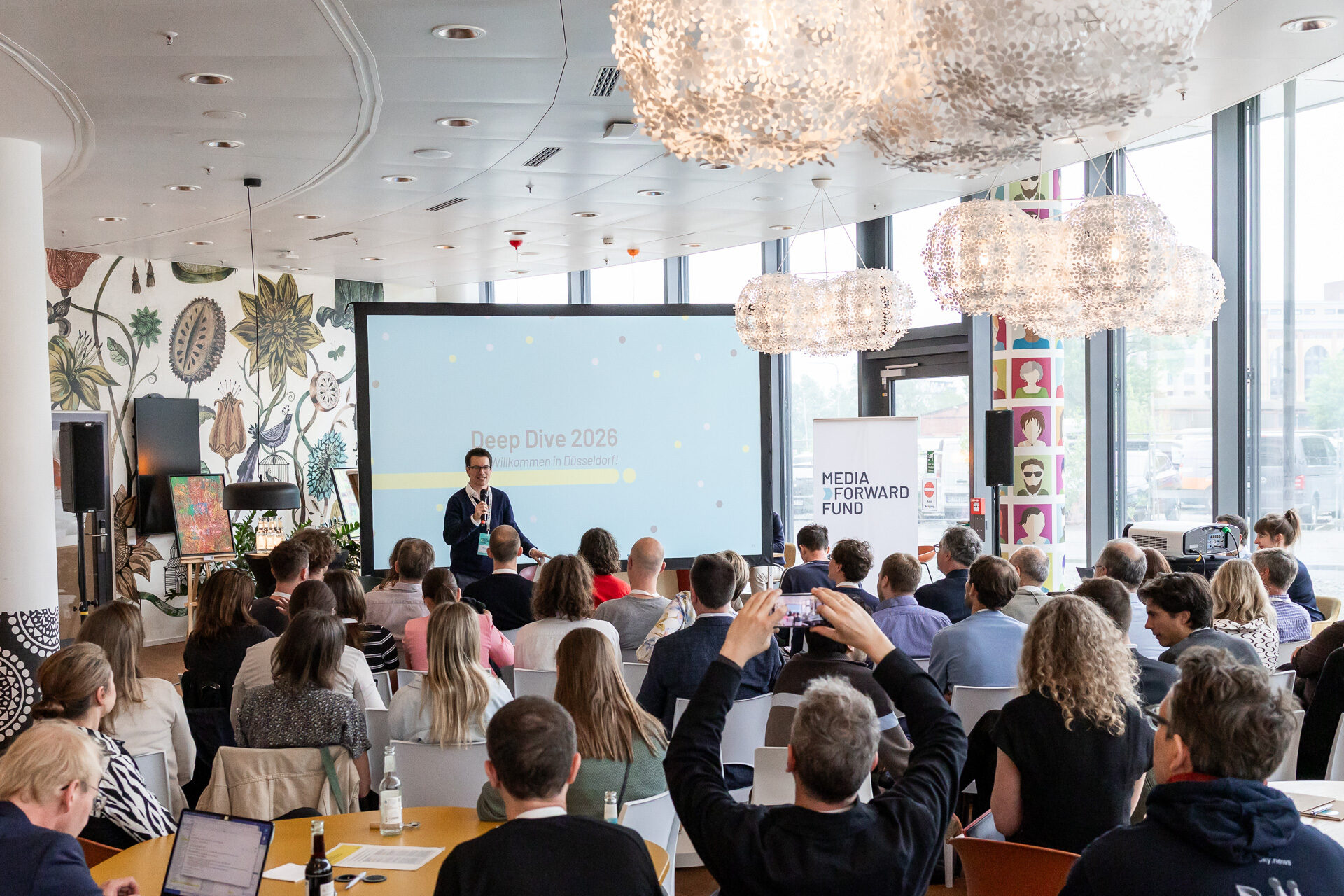
How can public-interest business models grow and become even more successful? Developing strategies, sharing practical tips, and finding the courage to try something new: Around 85 media professionals from across the DACH region gathered in Düsseldorf on May 5 and 6 for our Deep Dive. Every day, they are shaping the future of journalism.
Our seven key takeaways from the two-day program:
1. Merch with minimal effort
Merchandise works especially well when it allows people to express something about themselves.
One local media organization shared how they initially sold the “wrong kind of merch”: T-shirts with a large logo in every size and color. But no one wanted them – there was no emotional connection, and the return rate was high. They have since shifted to pool slides featuring a printed ZIP code and subtle branding. To keep costs low, the slides are only produced once pre-orders have been placed. The product works because it communicates identity and community.
What is often underestimated with merch is the logistical effort involved. Several media organizations therefore shared the same key lesson: outsource production and shipping as early as possible and factor those costs into pricing from the outset. To minimize returns, another local media outlet only sells products with naturally low return rates, such as pins.
Products with a strong local connection or customization options, minimal branding, low return rates, and fully outsourced production and shipping were among the most successful examples presented during the Deep Dive.
2. Advertising as a revenue stream
Advertising funds development, stability, and independence – when it is understood as an integral part of a public-interest business model. It is not just about generating revenue, but also about reaching new audiences. Advertising works particularly well when it aligns with the brand and becomes part of the user experience – not interrupting it but ideally enhancing it.
Many organizations are still hesitant about this. In order to succeed, a shift in mindset is required: setting prices confidently, actively advocating for quality, and building long-term customer relationships instead of focusing solely on short-term sales.
The key takeaways from Düsseldorf:
- Invest in the customer journey: Responsibility, motivation, and expertise should first be established at the highest level in sales. The customer experience should be regularly reviewed for efficiency gains and quality issues – it is even more important than the media performance itself and leads to customers returning and increasing their cart value.
- Stay authentic: Treating advertising as part of the user experience only works when the entire team collaborates to develop, discuss, test, and refine ideas – while fully safeguarding editorial independence. Only then does advertising truly fit the brand and the DNA of the newsroom. Balance is essential: a 60:40 ratio can serve as a guideline. No more than that; less is always possible.
- Editorial independence comes first: If an advertiser withdraws because of critical reporting, so be it. Editorial freedom matters more than any individual advertiser.
3. Repurpose events to build a community
Events alone do not create trust. But they can make trust visible and strengthen it. This has become especially relevant in local dialogue formats and community events.
One particularly compelling approach came from a local media organization in a rural area: take people’s frustration seriously, use it as a starting point for conversations, and create spaces where readers can speak for themselves. At the same time, these events generate valuable content for social media, newsletters, and reporting. The event itself becomes proof that “we’re listening.”
4. Be bolder with urgent membership campaigns
Whether it is a subscription or a crowdfunding campaign, people are more likely to support when they clearly understand why it is needed. The most successful campaigns communicate directly and transparently. The message is usually about either survival or growth. Many participants described an initial reluctance to ask for money. But the “sledgehammer” approach works – provided there is a clear explanation of why support matters.
Particularly important: make concrete goals visible, share progress openly, and celebrate milestones together. This gives supporters the feeling of being part of a shared mission. Many examples also showed that non-paying fans, in particular, can be mobilized through honest communication about what is at stake – or what could become possible.
5. Hyperlocal posters for the funnel
A physical presence can generate highly relevant reach and strong conversion rates—an innovative strategy used by an urban local media organization: hyperlocal flyers, designed as simple but eye-catching formats, play a key role in driving subscription growth.
Whenever a highly localized story appears in the newsletter, student workers distribute flyers to doors in the affected streets. The content is tailored specifically to the relevant neighborhood or block. Distribution of 200–300 flyers is timed to coincide with publication of the article. One practical tip: avoid high-rises, where flyers are often removed, as well as single-family homes. Instead, focus on side streets in residential areas rather than major thoroughfares.
The key ingredients are attention-grabbing hooks, a hyperlocal focus, and a seamless digital connection through a QR code. Since implementing this strategy, subscriptions have increased significantly, with acquisition costs averaging around €1.50 per new subscriber.
6. Nonprofit status does not mean sacrifice
One important lesson from several discussions: nonprofit status does not mean media outlets have to “stay small” or avoid economic ambition. While profits cannot be extracted, professional work, competitive salaries, and entrepreneurial thinking are explicitly allowed.
What matters is a clear separation between the different spheres and a well-defined structure. Especially for public-interest media organizations this model can create stability while safeguarding journalistic independence over the long term.
7. A strong brand forms is foundation for conversion
Branding is the first and most important step – everything else should reinforce it, because this is where the value proposition lives. Why should someone read, support, or subscribe in particular? Organizations that clearly communicate their mission and deliver tangible value build trust, provide orientation, and foster loyalty.
The website becomes the brand’s flagship: not just a news feed, but a showcase for concrete value – the reason someone should pay for a subscription. Content that offers practical help, creates moments of surprise, or strengthens a sense of community performs especially well. And: quality beats speed. Strong brand moments should be strategically leveraged to drive conversion.
In short: growth and subscription expansion depend on whether people understand your mission – and want to be part of it.
Last updated: May 13, 2026